National Institute of Information and Communications Technology (NICT)
Japan gets a 5G NTN test facility

5G NTN’s domestic test facility will do more than simply make it possible to start satellite communications: It will pave the way for cars and drones to stay connected as they move and fly, without losing their satellite or cellular connections. The National Institute of Information and Communications Technology (NICT) and Sharp have built the facility at the Kashima Space Technology Center and aim to begin operating it by the end of 2026. If terminals become smaller and handovers more reliable, a delivery vehicle’s operations screen could switch to a satellite connection even on a local road where torrential rain has knocked out cellular base stations.
When cars travel through mountainous areas or offshore, and when drones fly, they enter places where cellular signals cannot reach. Satellite communications can fill the gap, but satellite systems differ from one operator to another, making it difficult to use the same terminal across multiple services. Developers testing vehicle-mounted terminals and communications in Japan have often had to rely on overseas test facilities because domestic facilities were limited.
A test for connecting satellites and cellular networks
5G NTN is a communications standard for using the 5G technology that has spread on the ground for satellite communications as well. Cellular base stations can efficiently provide communications capacity in places with many people. On the other hand, it is difficult to cover offshore and mountainous areas, or places where base stations have been lost to disasters, using only terrestrial networks. Satellites can fill those gaps, but the distance from the terminal to the satellite, the satellite’s movement, obstructions caused by buildings and terrain, and weakening signals caused by weather all affect communications quality.
What matters is not simply being able to connect to a satellite. When a car moves from a satellite’s coverage area to a terrestrial cellular network, the connection must not be lost. This switch is called a handover. For applications involving remote monitoring or safety, maintaining communications at the moment of the switch is more important than achieving the highest speed.
A connection test site built in Kashima
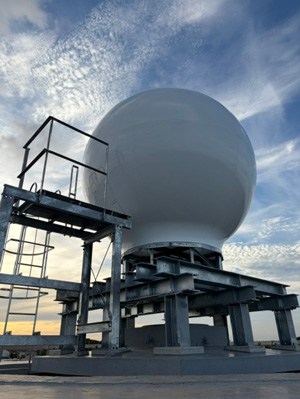
The National Institute of Information and Communications Technology (NICT) and Sharp have built a facility for testing 5G NTN at the Kashima Space Technology Center in Kashima, Ibaraki Prefecture. At its center is a Ka-band parabolic gateway antenna that connects a satellite communications system with terrestrial communications infrastructure. Combined with network-control equipment and other components, it makes it possible to verify connections between satellites and terrestrial networks in Japan. The two organizations have obtained the licenses required for satellite communications and aim to begin operating the facility by the end of 2026.
Once operations begin, satellite communications user terminals will be mounted on automobiles and drones to test communications quality and stability while they are moving. The facility will also be used to verify whether communications can switch from a terrestrial cellular network to satellite communications, and back again, without losing the connection. What has been resolved is not satellite communications themselves, but the practical barrier that has made it impossible to test “connections that don’t break while moving” in Japan.
A road where the operations screen stays visible even outside coverage
If the facility begins operating and the interconnection of terminals, satellites, and terrestrial networks, as well as handovers while moving, can be demonstrated, developers in Japan will be able to repeatedly test satellite communications for vehicles and drones domestically. For example, even on a local road where torrential rain has knocked out cellular base stations, a delivery vehicle’s operations screen could switch from a terrestrial connection to a satellite connection. That would spare the operations manager from having to keep calling to check whether the vehicle’s location reports had disappeared.
There are conditions to be met before that can happen, however. Standard-compliant terminals must be made smaller and lighter, and the reliability of communications quality and handovers while moving must be confirmed. Connections to satellite services, licensing, and commercial operations also need to be put in place. The facility is a starting point for testing; it does not mean that communications unaffected by cellular dead zones will be available immediately.