New Energy and Industrial Technology Development Organization (NEDO)
Select 1 million candidates in 6 hours with droplet culturing

The key to exploring microorganisms is not selecting a large number of candidates, but whether microorganisms that could not previously be cultured can be recovered as living strains. A research team linked together a process that cultures microorganisms in tiny droplets and selects and recovers about 1 million of them. If put into practical use, the day when enzymes derived from soil microorganisms become ingredients in detergents could arrive—provided the strains can be safely mass-produced under suitable conditions.
The search for useful microorganisms and enzymes still involves culturing and examining them one at a time. When there are many candidates, the search can take months or even years. What is more, many microorganisms in the environment do not grow under ordinary conditions. They had been falling out of the pool of candidates before their functions could be determined.
Measuring whether they actually grow
In biomanufacturing, finding microorganisms that produce a target enzyme or substance is the starting point for breeding and mass production. Even if their functions can be predicted from gene sequences, it is impossible to know whether they will grow in actual culture, or how much enzyme they will produce, without measuring it.
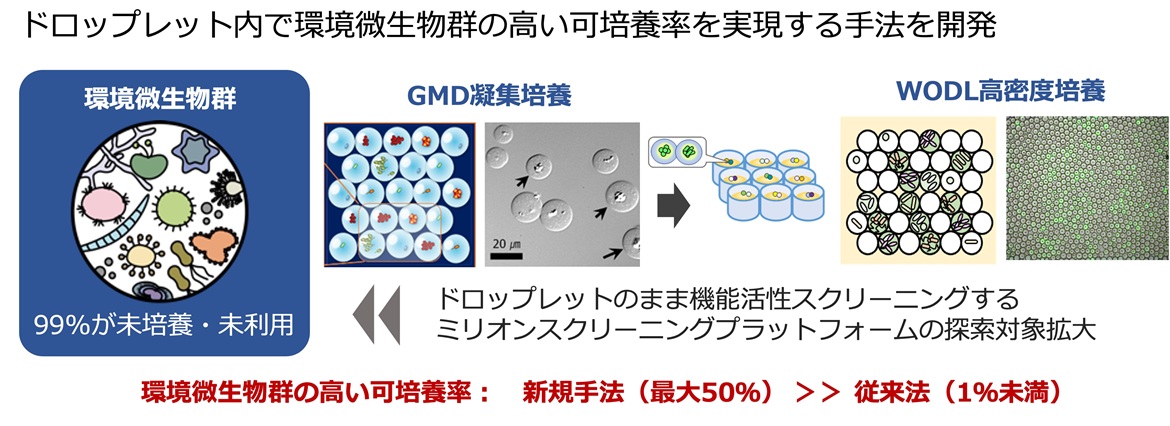
This is where droplets come in. Microorganisms are enclosed in gels or water droplets measuring around several dozen to 100 micrometers in diameter. Each droplet serves as a tiny culture vessel, allowing large numbers of them to be examined simultaneously. However, if living microorganisms cannot be taken out of droplets that show a good reaction and carried forward into the next culture, the discovery ends there.
Turning tiny vessels into a screening device
The research team linked together a process that grows microorganisms inside droplets, selects them while measuring their growth, enzyme activity, and production capacity, and then recovers them. By aggregating microorganisms or culturing them at high density, the team says it can make up to about 50% of microorganisms in the environment culturable.
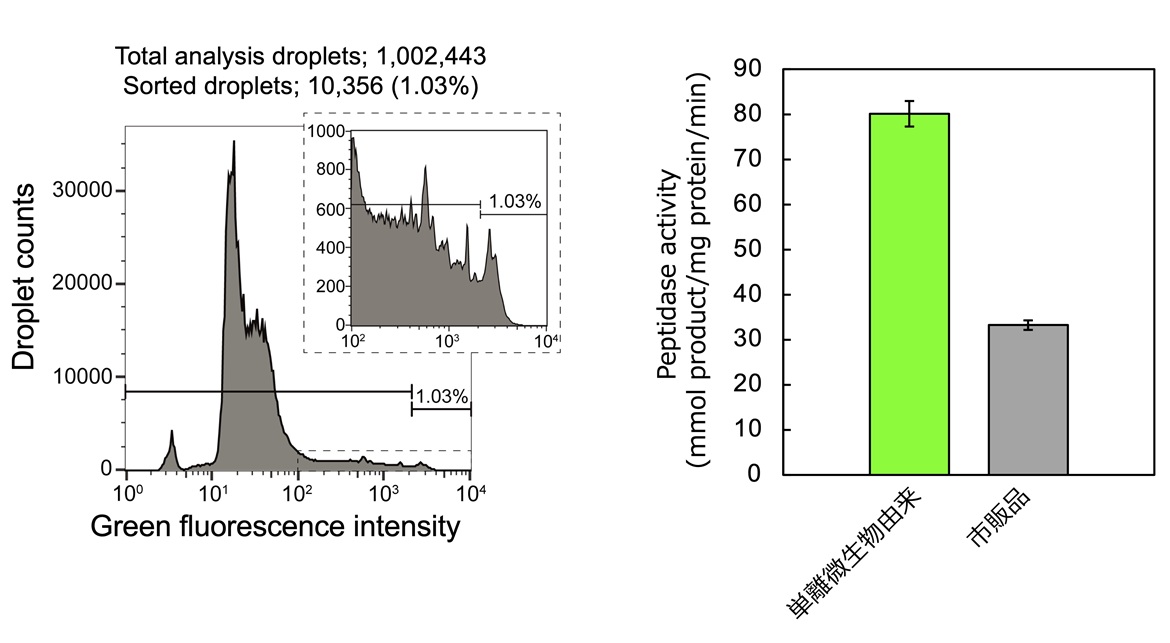
Using soil samples from a university campus, the team analyzed and sorted about 1 million droplets in 6 hours and obtained four bacterial species with high endopeptidase activity. From one strain of Lysobacter soli, it isolated a new enzyme with activity 2.4 times that of a commercial industrial enzyme used for peptide analysis. The system combines high-speed primary screening, secondary screening using images and machine learning, and dispensing into plates followed by recovery.
A day when detergent enzymes come from soil
If this system can be reproduced with environmental samples and continues to operate reliably after commercialization, exploration will shift from examining a small number of known strains one by one to narrowing down large groups of candidates in a short period. In the detergent aisle, enzymes in household detergents may one day come from soil microorganisms that could not previously be cultured or studied.
However, challenges remain in stably culturing the strains that are found at an industrial scale and putting them into a production process. The strains must be safely mass-produced and meet the performance and price requirements of existing products. Test operations are scheduled to begin in fiscal 2027, with commercialization planned for the end of the same fiscal year.