New Energy and Industrial Technology Development Organization (NEDO)
Surgical AI puts the reasoning behind operations into words

Surgical AI’s challenge is not the accuracy with which it identifies organs, but whether it can transfer the reasons behind experienced doctors’ decisions to other settings. Delyva demonstrated a surgery-specific AI in a university hospital operating room and achieved 84.7% anatomical accuracy in evaluations by surgical specialists. If its safety is demonstrated and regulatory approval is obtained, young doctors in regional operating rooms may be able to use Japanese to check the reasons behind procedures and the next steps for confirmation.
AI for endoscopic surgery could identify organs and blood vessels in images, but it could not address what procedure was being performed or why the next decision was needed. The judgments of experienced surgeons are embedded in their individual experience. For young doctors and regional hospitals, differences in educational opportunities and experience can lead to differences in the care patients receive.
AI that reads the context of surgery
A visual-language model is an AI system that looks at images or video and asks or answers questions about what it sees in words. Surgical footage includes bleeding and smoke, obstructions caused by instruments, and anatomical differences between patients, making it difficult even to interpret the images. What looks like a plausible explanation in an image and advice that is safe for a patient are separate issues. To use such a system in clinical settings, it needs not only strong performance but also validation across different institutions and procedures, safety measures for malfunctions, and regulatory review.
Putting the reasons for procedures and the next steps into words
Delyva built a Japanese surgery-specific visual-language model that links surgical footage with surgical knowledge. It handles in language not only the objects visible in the footage, but also the procedure being performed, the reasoning behind it, and the next step. Surgeons created specialist data divided into four categories—Object, Action, Reason, and Plan—and used it to tune the AI.
The company conducted a real-time demonstration in a university hospital operating room. In its evaluation, the system achieved 84.7% anatomical accuracy and 82.9% clinical usefulness when assessed by surgical specialists. The company says this is Japan’s first development and clinical demonstration of a surgery-specific generative AI that understands and interacts about surgical situations in real time. The results of its work under NEDO and the Ministry of Economy, Trade and Industry’s GENIAC program won the Innovation Award at CEATEC AWARD 2026.
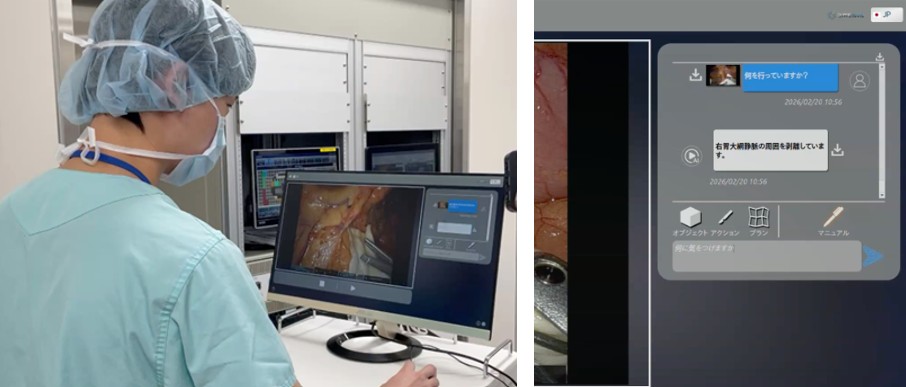
Conditions for sharing knowledge in the operating room
If this level of accuracy is maintained across different types of surgery and hospitals, and the system meets safety and pharmaceutical and medical-device regulatory requirements, young doctors in operating rooms at regional hub hospitals could look at an endoscopic display and use Japanese to check the structures they can see, the reasons for caution, and the next steps to confirm. The initial aim is to provide it for surgical education for young surgeons, medical students, and regional core hospitals. In the future, the company plans to support the presentation and confirmation of information during surgery after completing regulatory procedures, and then expand into partial automation.
However, an evaluation in the 80% range by specialists is not grounds for entrusting AI with decisions made during surgery, where mistakes are difficult to tolerate. Demonstrating safety across multiple procedures and obtaining regulatory approval are prerequisites. Can knowledge that surgeons have conveyed by working alongside colleagues for many years be transferred into educational data and an interactive system? Once that barrier is overcome, AI will become a tool for sharing the reasons behind decisions, rather than merely a tool for finding organs in images.