New Energy and Industrial Technology Development Organization (NEDO)
With synthetic-route AI, chemists return to the lab

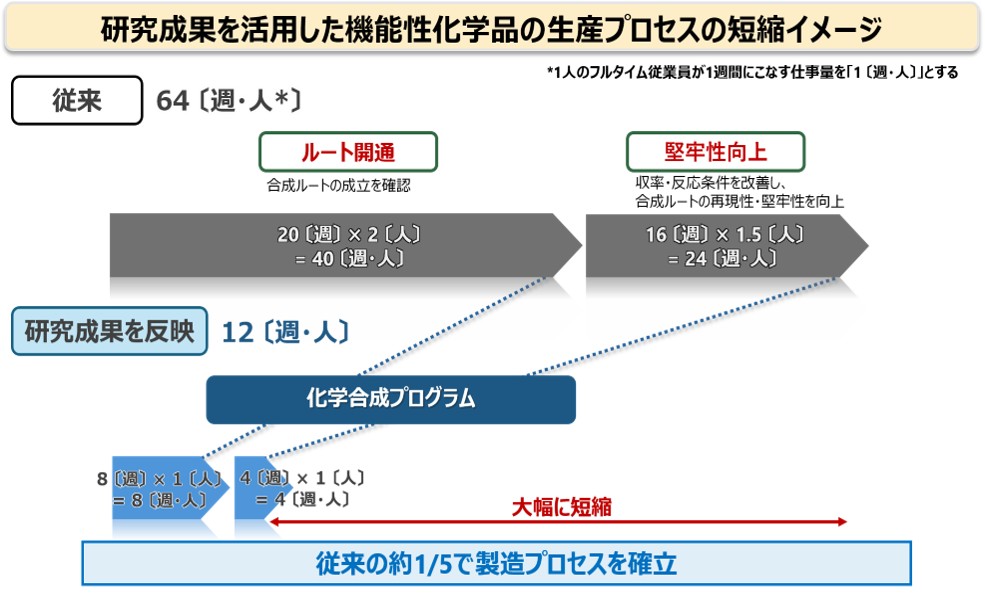
Synthetic-route AI shortens the search for candidates before experiments, not the experiments themselves. TS Technology and Nara Institute of Science and Technology reduced the workload for examining pharmaceutical synthesis from 64 person-weeks to 12 person-weeks. If the predicted routes work from experiments through mass production, development laboratories can quickly test the reactions that have been narrowed down.
To make functional chemicals, researchers must first decide how to assemble the molecules—in other words, the synthetic route. Today, researchers move back and forth among the literature, their experience, computational tools, and experiments as they compare enormous numbers of candidates one by one. The time and labor consumed simply by searching for candidates add to the time needed to turn pharmaceuticals and electronic materials into products, as well as to the burden of determining conditions for stable production in factories.
Finding a route does not guarantee a product
Even if a combination of chemical reactions is theoretically possible, factories face other problems. They may produce only a small amount of the target substance. Other substances may be mixed in. Researchers must also determine whether the raw materials can be purchased, whether the product can be separated and purified, and whether the equipment can be used safely.
Quantum chemistry calculations provide a way to understand reactions from the movement of atoms and predict how likely they are to occur. However, they do not completely replace complex experimental conditions or the behavior of a process during mass production. Even if route searches become faster, experiments, safety checks, and confirmation of mass-production conditions remain necessary.
AI first screens enormous numbers of candidates
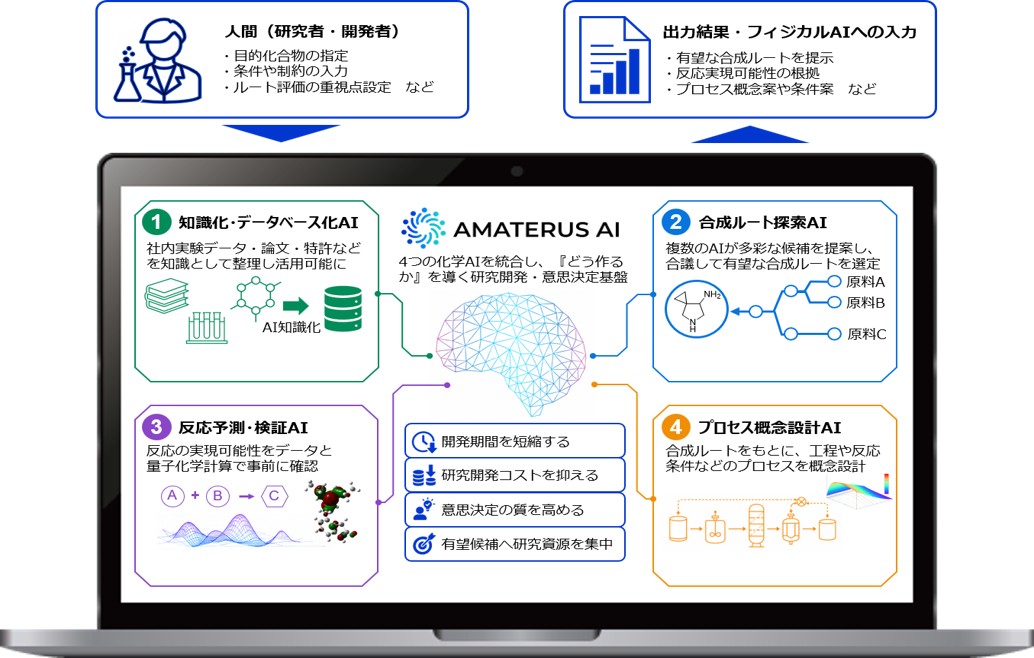
In a project led by the New Energy and Industrial Technology Development Organization (NEDO), TS Technology and Nara Institute of Science and Technology combined quantum chemistry calculations with AI that turns knowledge into databases, AI that searches for synthetic routes, AI that predicts and verifies reactions, and AI that considers rough designs for manufacturing processes. The program selects and evaluates enormous numbers of proposed synthetic routes according to the objective.
Instead of having people read the literature, manually compare candidates, and then conduct experiments, the program first narrows down the candidates, after which people verify the promising reactions. The project says it has demonstrated that pharmaceuticals can in fact be manufactured using routes proposed by the program, helping shorten the development period. In an evaluation of pharmaceutical synthesis studies, the workload fell from 64 person-weeks to 12 person-weeks.
Chemists return to verifying experiments and mass production
When the search for candidate routes becomes shorter, chemists can use flasks and small continuous-flow devices to quickly check whether reactions really occur and whether the products can be separated and purified. They can also devote time to tasks that cannot be decided from a screen alone, such as determining whether the same results can be reproduced in a factory and whether production can be carried out safely. The targets include not only pharmaceuticals but also functional chemicals such as pesticides, fragrances, and electronic materials.
In the laboratories of chemical manufacturers, instead of spending weeks moving through the literature, researchers could receive a set of narrowed-down routes and begin by testing the conditions most likely to fail. TS Technology will offer a service using this program from September 30, 2026. However, the condition is that the predicted routes work through experiments, purification, and mass production, and can be used at many development sites. For pharmaceuticals, the time required for clinical trials, regulatory review, and quality assurance will remain separate.